Just the other day, I visited a home that had nests with burrows in a landscaped area with wasps flying about. The wasps are cicada killer wasps. Wendi Hartup, Area Natural Resources Extension Agent, in Forsyth and Stokes Counties wrote a great article, Watch Out for the Cicada Killer!
 |
| Cicada Killer Wasp |
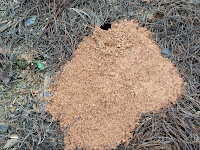 |
| Cicada Killer Wasp Nest |
An interesting note, the next day, a person dropped off a bug to be identified. It was a Velvet Ant. The Velvet Ant is actually a wasp. Most species of velvet ants are parasites of other bees including the Cicada Killer. Now what are the chances??? Maybe I should introduce these two individuals.
 |
| Velvet Ant |
A backyard aquaculture workshop is scheduled for Monday, November 21 at 6:00 pm at the McDowell County Extension Center, 60 East Court Street, Marion (2nd Floor of the County Administration Building). If you have a pond, learn how to grow your own fish, and have homegrown trout and catfish for dinner with your homegrown veggies! There is a registration fee of $5/$7 for couples. Make checks payable to: McDowell Cooperative Extension. Mail to McDowell Cooperative Extension, 60 East Court Street, Marion, NC 28752. Call Molly Sandfoss or Jane McDaniel at 828-652-8104 with questions. Must register by November 17.
Fall is the best time for renovating and seeding cool-season lawns. The cooler weather and more rainfall makes it a good time. If you wait until spring to seed, the newly established tall fescue lawn will not survive the heat and drought period in summer. You didn't give the grass enough time to establish. So don't delay seed in the fall.
The optimum air temperatures for tall fescue germination are 68 to 77 F and the soil temperature greater than 60 F. It is important to do it as early in the fall as possible in order to get these optimum conditions.
To get accurate liming and fertilization requirements, performing a soil test is recommended. A general suggestion for a yearly nitrogen application is approximately 1 lb of nitrogen fertilizer per 1,000 square feet of lawn. A soil test is highly recommended if you haven't done so.
Also, mow at a proper height (3.5") to allow the fescue to mature before winter.
The McDowell County Center has a publication, "Carolina Lawns" with information about cultivars appropriate for this area and other good management practices for your lawn.
HOT Topics are topics that seem to generate a lot of interest/questions.
It's Spring and all is a buzz in our lawns and gardens, literally. Quite a few people have been inquiring about a swarm of bees in their lawn. These bees are known as Ground Dwelling Bees. These are a "solitary" bee as opposed to a "social" bee like the Honey Bee. Ground Dwelling Bees dig holes in the ground for their nest. They emerge in March and April and reproduce from March until May. The female will dig a burrow at night, and during the day, she will collect pollen and nectar. She sticks the pollen and nectar into her burrow. She then will lay an egg on the pollen and nectar where the larvae will feed until they emerge as adults next March or April. These bees are not aggressive.
The holes in your yard are unattractive, but on the positive side, it does help to aerate your lawns. The Ground Dwelling Bee likes to nest in bare dry spots. Water this area and plant some vegetation to reduce the likelihood that the bee will nest. If you have a spot that grass is difficult to grow, call the office 652-8104, and we can discuss different ground covers that might work better in that location.


